
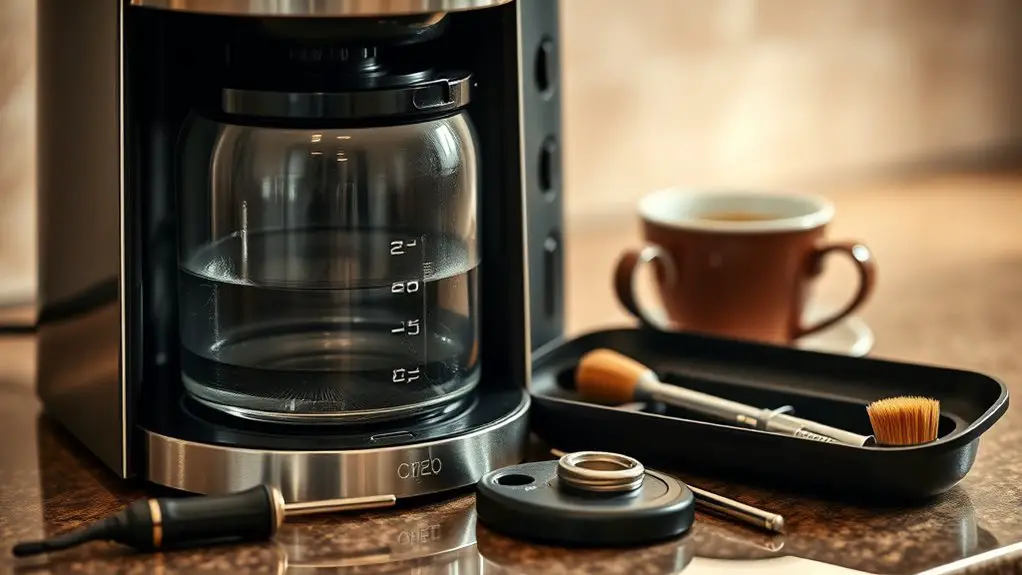
If your coffee maker won't pump water, start by checking the water reservoir for appropriate levels and debris. Inspect the water pump and tubing for blockages or leaks, and verify connections are secure. Clean the coffee maker to prevent build-up, and examine the filter for clogs. Review your brew cycle settings for accuracy, and assess the heating element for continuity. For detailed troubleshooting steps, you'll find more helpful insights ahead.
Check the Water Reservoir
Before diving into more complex issues with your coffee maker, it's essential to check the water reservoir, as many common problems stem from inadequate water supply. Start by inspecting the reservoir capacity; it should be filled to the appropriate level. If the water level is too low, the machine may not function properly, leading to under-extracted coffee or no brewing at all. Make sure there's no debris obstructing the reservoir, which could prevent proper filling. If your model has a float indicator, verify it's working correctly, as this can affect your water level readings. Finally, confirm the reservoir is firmly seated in place to avoid leaks and maintain an adequate supply for ideal brewing.
Inspect the Water Pump
The water pump is a critical component of your coffee maker, responsible for moving water from the reservoir to the brewing chamber. To inspect it, first, unplug the machine and remove any covers to access the pump. Look for signs of water pump issues, such as leaks, blockages, or strange noises during operation. Check the connections for wear or damage, guaranteeing they're secure. Use a multimeter to test the pump's electrical continuity—if it's faulty, replacement may be necessary. For pump maintenance tips, regularly clean the pump housing and verify it's free from mineral buildup. By keeping an eye on these details, you'll enhance your coffee maker's performance and extend its lifespan.
Clean the Coffee Maker
To maintain peak performance, you need to descale your coffee maker regularly, as mineral buildup can hinder functionality. Additionally, it's crucial to clean the water reservoir frequently to prevent mold and bacteria growth. These steps will guarantee your coffee maker brews efficiently and produces the best flavor. Regular descaling every 3 to 6 months ensures optimal condition and flavor retention.
Descale Regularly
Descaling your coffee maker at least once every three months is essential for maintaining its performance and extending its lifespan. Regular descaling eliminates mineral buildup, ensuring ideal water flow. To establish a descaling frequency that suits your usage, monitor your water quality; hard water may necessitate more frequent maintenance. You can use commercial descaling solutions or a homemade mixture of vinegar and water. For the latter, combine equal parts of each and fill the water reservoir. Run a brewing cycle, then let the solution sit for 15-30 minutes before rinsing with fresh water to clear any residue. By adhering to this descaling process, you'll preserve your coffee maker's efficiency, leading to a consistently great brew every time.
Clean Water Reservoir
Although you may not think about it often, keeping the water reservoir of your coffee maker clean is crucial for ideal performance. Neglecting this part can lead to poor water quality, affecting your brew. Here's a methodical approach to reservoir maintenance:
- Empty the reservoir: Remove any remaining water to prevent stagnation.
- Use a mild detergent: Clean with warm, soapy water to eliminate residue.
- Scrub gently: Use a soft brush to reach corners without scratching.
- Rinse thoroughly: Confirm no soap remains, as it can alter flavor.
- Dry completely: Wipe with a clean cloth to prevent mold growth.
Examine the Filter
To guarantee peak performance of your coffee maker, you need to examine the filter for any clogs. Inspect the filter for buildup or debris that could obstruct water flow, and if necessary, clean or replace it. A clear filter is essential for brewing a consistent and flavorful cup of coffee.
Check for Clogs
Before diving into more complex repairs, it is essential to check for clogs by examining the filter, as a blocked filter can greatly impede your coffee maker's performance. To guarantee smooth operation, follow these maintenance tips for effective clog prevention:
- Remove the filter: Take out the filter basket for a thorough inspection.
- Inspect for debris: Look for coffee grounds or mineral buildup that may be obstructing flow.
- Rinse thoroughly: Clean the filter under running water to dislodge any trapped particles.
- Check filter type: Confirm you're using the correct filter for your model, as some are more prone to clogging.
- Regular maintenance: Establish a routine for checking and cleaning the filter to avoid future issues.
Clean or Replace Filter
After checking for clogs, it's important to focus on the filter itself, as a dirty or worn filter can greatly affect your coffee maker's efficiency and the quality of your brew. Begin by removing the filter and inspecting it for any debris or buildup. If it's reusable, give it a thorough cleaning with warm, soapy water, ensuring all residues are gone. For best filter maintenance, consider replacing it if it shows signs of wear or damage. If you're using disposable filters, replace them regularly to maintain consistent performance. Remember, a clean filter is vital for achieving the rich, flavorful coffee you desire, so don't overlook this essential step in your coffee maker upkeep.
Look for Blockages in the Tubing
While troubleshooting your coffee maker, checking for blockages in the tubing is essential, as even minor obstructions can disrupt the brewing process. Regular tubing maintenance can help prevent issues, but if you're experiencing problems, consider the following blockage causes:
- Mineral buildup from hard water
- Coffee grounds or debris accumulation
- Kinks or bends in the tubing
- Insects or foreign objects trapped inside
- Deterioration of the tubing material
To identify blockages, visually inspect the tubing for any visible obstructions. You might also use a small brush or a pipe cleaner to clear out any stubborn debris. Addressing these blockages promptly will guarantee your coffee maker functions smoothly, letting you enjoy your favorite brew without interruption. Additionally, be aware that scale buildup on the group head can also contribute to water flow issues in espresso machines, highlighting the importance of regular maintenance.
Test the Power Source
One vital step in troubleshooting your coffee maker is to test the power source, as electrical issues can prevent it from functioning altogether. Begin by checking if the coffee maker is plugged in securely; loose electrical connections can lead to intermittent power. Next, inspect the power outlet by plugging in another device to confirm it's working. If the outlet is fine, consider the coffee maker's power cord for any visible damage or fraying. If you're using a power strip, bypass it and connect directly to the wall outlet. Finally, if you still face power issues, the internal components, such as the fuse or the switch, may require further investigation or replacement. Ensuring a steady power supply is vital for ideal performance, and regular maintenance can help prevent issues like clogged water lines.
Review the Brew Cycle Settings
To guarantee your coffee maker is operating at its best, start by checking the brew cycle timing to confirm it's set correctly for your desired brew time. Next, adjust the brew strength settings to match your taste preferences, which can greatly impact the flavor. Finally, consider resetting the brew cycle options if you've made any previous adjustments that may have inadvertently affected performance.
Check Brew Cycle Timing
As you troubleshoot your coffee maker, checking the brew cycle timing is essential for guaranteeing peak performance. Misaligned timing can lead to inadequate extraction, affecting the flavor of your coffee. Here are some steps for effective timing adjustments:
- Verify the brew cycle duration set on your machine.
- Compare the time against standard brewing times for your coffee type.
- Adjust the timing according to your coffee strength preference.
- Listen for any unusual sounds during the brew cycle.
- Monitor the flow rate of water to guarantee consistency.
Adjust Brew Strength Settings
After ensuring the brew cycle timing is accurate, the next step is to adjust the brew strength settings to fine-tune your coffee's flavor profile. Begin by locating the brew strength adjustment feature on your coffee maker. This may involve selecting options like "strong" or "regular." If your model allows for it, experiment with the amount of coffee grounds used; a higher ratio typically enhances flavor intensity. Monitor the brewing process closely, as a longer extraction time can also affect the outcome. Adjusting these settings not only caters to your personal taste but also empowers you to explore various flavor profiles. Remember, the right brew strength adjustment is essential for ideal coffee flavor enhancement, allowing you to enjoy every sip to the fullest.
Reset Brew Cycle Options
If you're experiencing issues with your coffee maker's performance, resetting the brew cycle options can often resolve the problem. Start by checking these settings to verify everything's functioning properly:
- Power Off: Unplug the coffee maker before adjustments.
- Reset Button: Locate and press the reset button, if available.
- Brew Cycle Duration: Confirm the timing settings for your brew cycle.
- Water Level: Verify the water reservoir is filled to the required level.
- Clean Cycle: Run a clean cycle to remove any build-up affecting performance.
Assess the Heating Element
The heating element is an essential component of your coffee maker, directly influencing its ability to brew hot coffee efficiently. To assess it, start with heating element testing. Unplug the coffee maker and use a multimeter to check for continuity. If there's no continuity, the element's likely defective and may require replacement. Before replacing the element, inspect the wiring for any damage or loose connections, which can also cause heating issues. If everything looks intact but the element still doesn't heat, proceed with element replacement. Make sure you obtain the correct part compatible with your model for peak performance. Once replaced, reassemble everything, plug it back in, and run a brew cycle to confirm that your coffee maker is back to life.
Consider Descaling the Machine
Since mineral buildup can severely affect your coffee maker's performance, descaling the machine is an essential maintenance step you shouldn't overlook. Regular descaling helps guarantee peak functionality and longevity. Here's how to proceed:
- Choose a descaling solution or use vinegar for its benefits.
- Mix the solution with water according to the instructions.
- Pour the mixture into the water reservoir.
- Run a brewing cycle without coffee grounds to circulate the solution.
- Rinse thoroughly by running a couple of cycles with clean water. Regular descaling can prevent issues like internal clogging or blockage.
Consult the User Manual
After descaling your coffee maker, it's important to consult the user manual for specific guidelines and troubleshooting tips tailored to your model. The user manual features detailed instructions that can help you identify common issues affecting water flow. Look for sections related to water pump operation; they often contain flow charts or step-by-step procedures. Pay attention to any model-specific recommendations, as they can provide insights into unique features or settings that may be causing problems. If your coffee maker still won't pump water, the manual might offer troubleshooting tips that include checking for clogs, ensuring proper assembly, or verifying power connections. Consulting your manual can save time and empower you to address the issue effectively.
Frequently Asked Questions
Can I Use Vinegar to Clean My Coffee Maker?
Yes, you can use vinegar to clean your coffee maker. Its benefits include descaling and removing buildup. For ideal performance, clean your machine every month to guarantee a great tasting brew and longevity.
How Often Should I Descale My Coffee Maker?
Descaling your coffee maker is like changing the oil in your car; it's essential for smooth operation. Aim for every three to six months, depending on water hardness. Consistent maintenance keeps your machine in top shape.
What Should I Do if My Coffee Maker Is Leaking?
If your coffee maker's leaking, check the water reservoir for cracks or improper placement. Verify coffee grounds aren't clogging the filter. Tighten connections and clean any spills to prevent further leaks, guaranteeing a hassle-free brewing experience.
Is It Safe to Use a Coffee Maker That's Not Pumping Water?
Imagine a car without fuel; it's not going anywhere. Similarly, if your coffee maker's not pumping water, it can pose coffee maker safety risks. Always address water pump issues before using it again to avoid potential hazards.
Can a Coffee Maker Be Repaired if It's Broken?
Yes, a coffee maker can often be repaired. Start with troubleshooting tips like checking for clogs or faulty components. If issues persist, explore repair options like replacing parts or consulting a technician for professional assistance.