
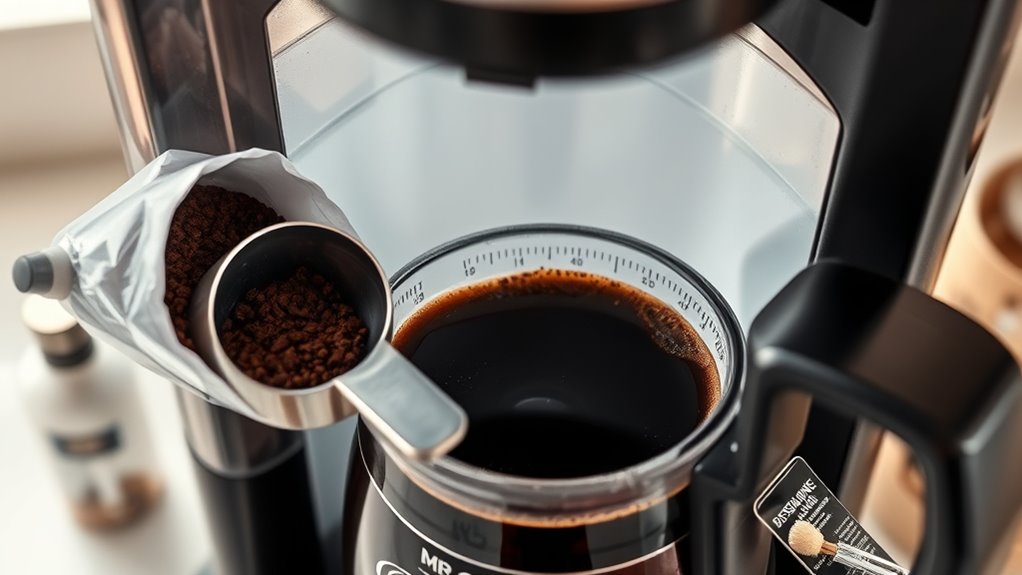
To fix your Mr. Coffee maker brewing weak coffee, start by checking the quality and grind size of your coffee grounds. Adjust the coffee-to-water ratio, aiming for 1:15. Clean your machine regularly to eliminate buildup and inspect water quality—filtered water works best. Confirm the brew basket and filter are clean and fit properly. Check brewing temperature and maintain your machine well. If you follow these steps, you'll uncover more insights to achieve a bolder brew.
Check the Coffee Grounds Quality
When brewing coffee, the quality of your coffee grounds plays a crucial role in the final flavor and strength of your brew. Start by evaluating the grind size; a consistent grind is necessary for ideal extraction. Using a coffee grinder with adjustable settings allows you to tailor the grind to your brewing technique. For instance, a coarser grind suits a French press, while a finer grind works better for espresso. Make sure your beans are fresh, as stale grounds can weaken your coffee's flavor. Experiment with different types of beans and roasting levels to find what resonates with your taste. Remember, the right grind not only enhances flavor but also guarantees a satisfying cup. Prioritize ground quality for a robust brew.
Adjust the Coffee-to-Water Ratio
To achieve a stronger brew, it's essential to adjust the coffee-to-water ratio. Ideally, you should use one to two tablespoons of coffee grounds per six ounces of water, depending on your taste preference. Measuring your coffee accurately and adjusting the water volume accordingly can greatly enhance the strength of your coffee.
Ideal Coffee Ratio
A balanced coffee-to-water ratio is essential for brewing a flavorful cup, and many experts recommend using a standard ratio of 1:15, which means one part coffee to 15 parts water. Adjusting this ratio can greatly affect your coffee strength and overall brew time.
- Experiment with different ratios to find your perfect brew
- Use fresh, quality coffee grounds for best results
- Keep your water temperature consistent for ideal extraction
- Adjust the grind size of your coffee for varying brew times
- Measure accurately to maintain consistency in flavor
Measuring Coffee Grounds
Measuring coffee grounds accurately is essential for achieving the desired strength in your brew. Start by determining the right coffee-to-water ratio, typically around 1 to 2 tablespoons of coffee per 6 ounces of water. Adjust this based on your taste preference. Consider the coffee grind; finer grinds extract flavor more quickly, while coarser grinds require longer brewing time. If your coffee's weak, you may need to increase the amount of coffee grounds or adjust the grind size. Use a kitchen scale or measuring spoon for precision, ensuring consistency in each brew. Don't forget to experiment within these guidelines until you find the perfect balance that suits your palate, enabling you to enjoy a stronger, more flavorful cup.
Adjusting Water Volume
Adjusting the water volume is essential for enhancing your coffee's strength and flavor. The right coffee-to-water ratio greatly impacts brewing strength, ensuring you enjoy a robust cup. Here's how to adjust it effectively:
- Use a standard ratio of 1:15 (coffee to water).
- Experiment with smaller increments to find your preferred strength.
- Gradually increase or decrease the water volume based on taste.
- Measure accurately using a scale or measuring cup.
- Keep a log of adjustments to track what works best.
Clean the Coffee Maker Regularly
Although you might not notice it immediately, regular cleaning is crucial for maintaining your Mr. Coffee maker's performance. Over time, coffee oils and mineral deposits accumulate, leading to weaker brews. To combat this, establish a cleaning schedule that fits your usage: ideally, clean your machine every month.
Start by emptying the carafe and water reservoir, then run a mixture of equal parts vinegar and water through a brewing cycle. This helps dissolve buildup. Rinse thoroughly with fresh water to remove any residual vinegar. Don't forget to clean the filter basket and carafe as well. By incorporating this routine into your coffee maker maintenance, you'll guarantee a consistently robust cup of coffee and extend the lifespan of your machine.
Inspect the Water Quality
Regular cleaning alone won't assure ideal coffee quality; the water you use plays a significant role in the brewing process. To guarantee your Mr. Coffee maker produces rich, flavorful coffee, inspect the water quality carefully.
- Check your water source for contaminants.
- Use filtered water to avoid impurities.
- Assess the hardness of your water, which can affect taste.
- Replace or maintain your filtration system regularly.
- Experiment with different water types to find what works best for you.
Assess the Brew Basket and Filter
Start by checking the quality of your filter; a worn or damaged filter can impede proper extraction. Next, verify that the brew basket is correctly positioned to facilitate ideal water flow. Addressing these two factors can greatly enhance your coffee's strength.
Check Filter Quality
When evaluating the brew basket and filter of your Mr. Coffee maker, you need to guarantee ideal filter quality. Poor filter maintenance can lead to weak coffee. Here are key aspects to take into account:
- Filter Type: Use the right filter type for your model.
- Cleanliness: Regularly clean or replace filters to avoid buildup.
- Fit: Guarantee the filter fits snugly in the brew basket.
- Brewing Capacity: Check if the filter can handle your coffee grounds' volume.
- Material: Choose between paper or reusable filters based on preference.
Ensure Proper Basket Placement
Ensuring proper basket placement is essential for ideal brewing in your Mr. Coffee maker. Misalignment can lead to weak coffee due to poor water flow and reduced brewing efficiency. Begin by checking the basket alignment; it should sit securely in its slot without any gaps.
| Check | Action |
|---|---|
| Basket Position | Make sure it's fully inserted |
| Filter Type | Use a compatible filter |
| Coffee Ground Amount | Adjust to the recommended dose |
Verify the Brewing Temperature
One critical factor in achieving a great cup of coffee is verifying the brewing temperature of your Mr. Coffee maker. If the temperature isn't suitable, your coffee may taste weak. Here's how to confirm proper temperature calibration:
- Check the temperature gauge, if available.
- Use a reliable thermometer to measure water temperature.
- Brew a test batch and taste for strength.
- Adjust the machine settings, if applicable.
- Experiment with different coffee grounds for better extraction.
Maintaining the right brewing temperature is essential for extracting those rich flavors and aromas. If your coffee remains weak, it's time to reassess your temperature calibration. By confirming your Mr. Coffee maker operates at the ideal brewing temperature, you can enjoy a more satisfying cup.
Ensure Proper Machine Maintenance
To achieve ideal performance from your Mr. Coffee maker, regular maintenance is key. Start by cleaning the machine every month to prevent buildup of coffee oils and mineral deposits. Use a mixture of equal parts water and white vinegar to run a cleaning cycle, followed by a couple of cycles with plain water. This not only enhances flavor but also boosts machine longevity.
Additionally, check the water reservoir and filter regularly; replacing them as needed guarantees best brewing conditions. Don't forget to descale your machine if you live in a hard water area, as this can greatly affect performance. Following these maintenance tips will help you enjoy consistently strong coffee and extend the life of your Mr. Coffee maker.
Experiment With Different Coffee Types
If you're not satisfied with the strength of your coffee, experimenting with different coffee types can make a significant difference. Various coffee varieties offer distinct flavor profiles that can enhance your brewing experience. Here are some options to explore:
- Arabica: Known for its smooth, mild flavor.
- Robusta: Provides a stronger, more bitter taste.
- Single-origin: Unique flavors from specific regions.
- Dark roast: Rich, bold taste with lower acidity.
- Flavored coffee: Infused with various additives for a twist. Additionally, selecting beans based on their roast level can significantly impact the flavor and strength of your coffee.
Consult the User Manual for Troubleshooting
After exploring different coffee types to enhance flavor and strength, it's important to contemplate the operational aspects of your Mr. Coffee maker. A solid first step is to consult the user manual for troubleshooting. It's packed with user manual tips that can help you pinpoint the issue quickly. Look for sections on coffee strength and brewing settings, as they often provide a troubleshooting guide tailored to common problems.
| Issue | Suggested Action |
|---|---|
| Weak coffee | Adjust grind size |
| Machine not brewing | Check water reservoir |
| Coffee over-extraction | Reduce brew time |
| Inconsistent temperature | Clean the machine |
Frequently Asked Questions
Can I Use Pre-Ground Coffee for Better Flavor?
Yes, you can use pre-ground coffee, but make certain it matches your coffee grind size preference and brewing method. Finer grinds suit espresso, while coarser grinds work better for drip or French press, enhancing overall flavor.
How Often Should I Descale My Mr. Coffee Maker?
You should descale your Mr. Coffee maker every three to six months, depending on your water hardness. Regular descaling is essential for peak performance, so follow these maintenance tips to guarantee great-tasting coffee consistently.
Does the Type of Water Affect Coffee Strength?
Yes, water quality greatly impacts coffee strength. If your water's hard or contains impurities, it can alter brewing temperature and extraction efficiency, leading to weaker coffee. Always use filtered water for ideal results.
What Are Signs My Coffee Maker Needs Replacing?
If your coffee maker shows inconsistent brewing performance, excessive noise, or leaks, it might be time for a replacement. These signs can indicate a decline in coffee maker longevity, impacting your overall coffee experience.
Can I Use a Paper Filter Instead of a Reusable One?
You can absolutely use a paper filter instead of a reusable one. Paper filters often provide better clarity and remove oils, while reusable filters offer convenience and sustainability—each choice has its unique benefits to evaluate.